On the morning of June 26, Greg Manteufel woke up believing he had nothing more than the flu.
He felt tired, a little feverish, and strangely weak, the kind of weakness that convinces a man he simply needs rest.
But within hours, everything he thought he understood about sickness, safety, and life itself would rupture in a way he could never have imagined.
As he stood in front of the bathroom mirror that day, Greg realized something was terribly wrong.
His face had turned a dark, alarming shade of red — not like a blush or a sunburn, but like blood pooling beneath the skin.

His legs were swelling so rapidly he could feel the skin stretching.
His breath came out in hot, uneven bursts.
And then came the diarrhea, the dizziness, the overwhelming sense that he was slipping away from himself.
Most people would panic.
Greg simply whispered to himself, “I need to sleep this off,” and crawled into bed in his home in West Bend, Wisconsin.
He barely felt the pillow under his cheek before consciousness started to fade like a light being switched off.
By the time his son, Mike, rushed in and saw him, Greg was unrecognizable.

His skin had shifted from red to deep blue-purple — the color of a three-day-old bruise.
His words were jumbled nonsense, tumbling out of his mouth like a broken radio signal.
Mike didn’t hesitate.
He put his father in the car and sped to the hospital, begging him to stay awake, but Greg drifted in and out, slipping deeper into confusion.
When they arrived, the emergency room erupted into motion.
Nurses surrounded him.
Doctors barked orders.
Machines wailed.
And Greg, aware enough to know he was dying, told one doctor, “Do whatever you need to do to save my life.”

Those were the last clear words he would speak before the nightmare fully took hold.
Within twenty-four hours, his feet turned pitch black.
Not bruised — dead.
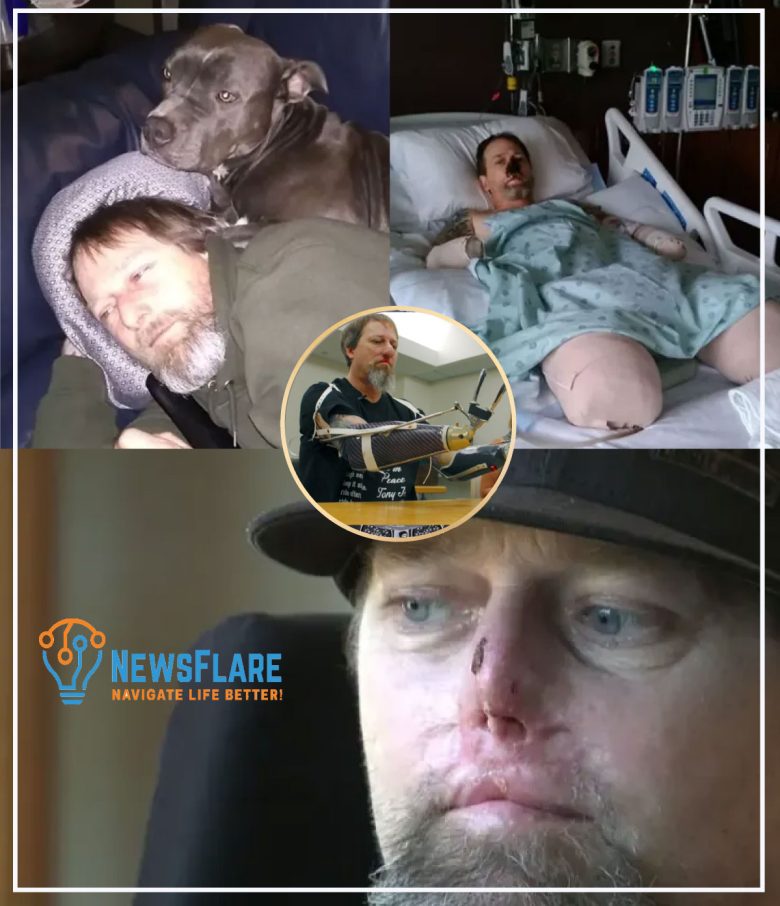
The surgeons removed both legs below the knee.
Then above the knee.
When his hands began to turn the same lifeless color, they, too, had to be amputated.
Then, parts of his nose.
Every time his wife, Dawn, walked into the hospital room, she braced herself for worse news.
For eight days, no one knew why Greg was dying from the inside out.
Doctors asked if he had been bitten by a tick.
If he’d wandered through the woods.
If a spider had attacked him.
Every answer was no.

Every hour was a countdown.
And yet, Greg kept fighting, suspended between life and death as his family waited for a miracle — or for an answer.
That answer finally arrived when an infectious disease specialist returned to the room with Greg’s lab results.
The doctor took a breath and said something no one could have anticipated.
Greg hadn’t been bitten by a tick.
Hadn’t been attacked by a spider.
Hadn’t eaten contaminated food.
He had been infected by a bacteria called Capnocytophaga canimorsus — a bacteria found in the mouths of dogs.
It can be passed to humans through a bite or even through a simple lick.
And in extremely rare cases, it can enter the bloodstream and create a catastrophic, deadly infection.
That is exactly what had happened to Greg.

A lifetime dog lover, he couldn’t believe it.
He had grown up with Labradors, Dobermans, and every kind of dog in between.
And now he shared his home with Ellie, an eight-year-old pit bull who adored him.
Greg refused to believe Ellie was responsible.
“She’s not a licker,” he insisted.
But even if she were, he said, “It wouldn’t be her fault. I love dogs. I always will.”
Doctors reminded him that the infection could have come from any dog he interacted with.

And just days before he fell sick, he had attended a birthday party surrounded by pets — at least eight of them.
There was no way to know which dog carried the bacteria.
All Greg knew was that life as he once understood it had vanished.
Over the next three months, he underwent fourteen surgeries.
Skin grafts.
Cleaning procedures.
Amputations.
Every day was a new battle against pain, fear, and the unrecognizable reflection staring back at him.
But Greg was not done living.
When he was finally stable enough, he began therapy at Froedtert Hospital in Milwaukee.
The therapies were not glamorous.
They were slow.
Painful.
Humbling.
He had to relearn everything — how to eat, how to shower, how to hold a phone.

His therapists fitted him with a Velcro wristband, a little strap with a pocket that could hold toothbrushes, forks, or styluses so he could text.
He practiced maneuvering his motorized wheelchair through narrow spaces.
He learned how to get dressed with no hands.
He learned how to shave with no arms.
He learned how to keep laughing even when everything around him seemed to have been taken away.
Through it all, Dawn was by his side, exhausted but unbroken.
They sold their two-story home because Greg could no longer climb the stairs.
They moved in with Greg’s parents.
They used every dollar they had for medical care.

Greg never once complained.
“I guess you just take what you get,” he would say.
“It is what it is. Stay positive, and don’t let it break you.”
His determination became the foundation of their new life.
But bills piled up.
Greg could no longer work as an exterior painter.
Medical equipment, prosthetics, surgeries — everything cost far more than they could afford.
So friends created a GoFundMe.
The donations began as a trickle.
Then became a stream.
Then a flood.

More than $130,000 arrived from strangers who saw Greg’s courage and wanted to help him stand — even without legs.
Dawn wept when she read the messages.
People from around the country wrote to say they were praying for him, rooting for him, inspired by him.
“It made us feel like we weren’t alone,” she said.
Greg’s goal is simple but monumental: he wants to drive again.
To feel the engine rumble beneath him.
To reclaim a piece of the independence he lost.
Prosthetics will help him walk someday.
Adaptive equipment will help him hold tools.
Nothing can replace the limbs he lost.

But Greg believes he can still build a life worth living.
Every night, Ellie — the dog some might blame — climbs onto his lap.
He cannot scratch her ears anymore, cannot run his fingers through her fur.
But he leans his face against her head and breathes in the warmth of a creature he refuses to fear.
“I don’t want anyone to be afraid of their dogs,” Greg says.
“This happened to me, but it doesn’t have to happen to anyone else. If we can spread awareness — maybe that’s the good that comes out of all this.”
He survived something almost no one survives.
He lost more than most people can imagine losing.
And yet — he remains grateful.
Hopeful.
Alive.

Greg Manteufel was nearly killed by a kiss from a dog.
But he refuses to let the ending of the story be about what he lost.
He insists it will be about what he rebuilds.
About the life he chooses to shape from the ashes.
And about the love — yes, love — for dogs that he never allowed fear to steal away.