
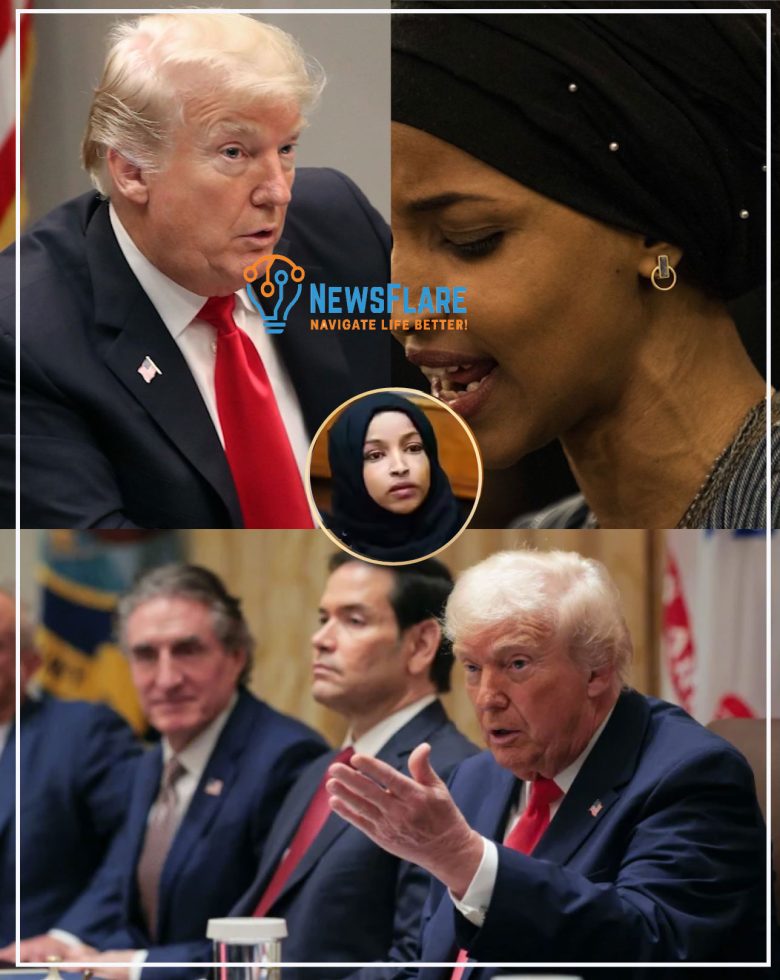
THE DECEMBER 6 SHOCKWAVE: TRUMP’S MASS SOMALI DEPORTATION ORDER AND THE FIRESTORM IT IGNITED
December 6 will be remembered not as an ordinary news cycle, but as a political earthquake — a moment when the United States witnessed one of the most explosive, controversial, and deeply polarizing decisions in its modern history. In a stunning overnight directive, former President Donald Trump ordered a fleet of aircraft to begin the forcible removal of Somali nationals from American soil, a move that instantly ignited chaos, panic, and a nationwide battle over the soul of the country.
The images began spreading within minutes: buses moving under heavy escort, airport perimeters sealed off, and communities scrambling to understand who would be taken, who was safe, and what exactly the administration had authorized. By dawn, the shock had already crystallized into something larger — a full-blown political firestorm that blurred the lines between immigration policy, racial tension, and high-stakes power.
To many observers, the operation was not merely an immigration action but a symbolic rupture, a drastic escalation of rhetoric that had been simmering for months. And at the center of the resistance stood Rep. Ilhan Omar, whose voice surged across the nation with an urgency unmatched in recent memory.
Her reaction was immediate and emotional: “This is not security. This is not policy. This is the weaponization of fear against a community that has given so much to this country.” For Omar, the order was personal, political, and existential — a challenge not only to Somali Americans but to the broader idea of what the United States claims to represent.
Yet even her impassioned objections did little to slow the machinery that had already been set in motion.
THE OPERATION: FAST, FORCEFUL, AND DESIGNED TO STUN
According to officials and eyewitness accounts, the deportation effort unfolded with an intensity that seemed calibrated to reduce resistance. Aircraft were mobilized with military-style precision, and entire neighborhoods with high concentrations of Somali residents found themselves under sudden surveillance.
Community centers became impromptu shelters. Hotlines crashed under the weight of frantic calls. In cities like Minneapolis, Columbus, and Seattle — home to some of the largest Somali communities — fear spread faster than information. Parents pulled children out of school. Small businesses shuttered. For many, it felt less like an immigration enforcement action and more like the abrupt erasure of an entire community’s sense of belonging.
Analysts quickly recognized the political significance of the operation. Trump had long built a brand on decisive action and nationalistic bravado, but this move represented something categorically different: a demonstration of power not in rhetoric but in physical removal, in planes, lists, and locked gates.
Critics called the operation unconstitutional. Supporters hailed it as necessary. But in the fog of the unfolding chaos, one thing became indisputable: America had been thrust into one of the most divisive moments of its modern political narrative.
ILHAN OMAR: A VOICE RISING AGAINST THE STORM
As the situation intensified, Ilhan Omar’s opposition evolved from criticism to full-scale moral indictment. Her speeches grew sharper, her warnings more urgent, and her supporters more mobilized. She insisted that the action was not about immigration violations but about racial targeting under the guise of national security.
Omar’s condemnation resonated profoundly with civil rights groups, legal scholars, and immigrant advocates who viewed the operation as a dystopian departure from American values. They pointed to an alarming precedent: if one community could be uprooted en masse, who might be next?
But Omar’s resistance also made her a target. Online attacks surged. Political commentators caricatured her as disloyal or hysterical. The more she spoke, the more polarized the public became. Yet she did not waver. Her message remained unambiguous: America cannot call itself a democracy while normalizing the forced removal of people based on ethnicity or origin.
THE RACIAL FAULT LINE REOPENS
To understand the explosive reaction, one must look beyond the politics and into the deeper historical wound that this action reopened. America’s relationship with race — fraught, unresolved, and repeatedly inflamed — surged back into the spotlight.
The Somali community, already vulnerable to stereotypes and discrimination, suddenly found itself painted as a collective threat. Advocacy groups warned of a dangerous normalization of racialized policy, arguing that the deportations echoed some of the darkest chapters of American history.
And yet, for many Americans sympathetic to Trump’s worldview, the action was framed not as racial targeting but as strength — a decisive return to border control, a restoration of national authority. This perspective, amplified by media ecosystems aligned with Trump’s narrative, further deepened the divide.
What emerged was a portrait of a nation struggling with its own identity: Is America a refuge or a fortress? A nation of immigrants or a nation in retreat? A democracy guided by moral principle or one willing to redefine itself through exclusion?
THE GLOBAL DIMENSION
The shockwaves extended far beyond U.S. borders. International organizations condemned the move. Human rights observers demanded immediate transparency. Somalia itself expressed outrage, arguing that the forced returns strained diplomatic norms and endangered lives.
Countries across Africa and Europe voiced alarm at what they described as a dangerous precedent for ethnic-based expulsions. Meanwhile, global media treated the event as a symbol of shifting Western politics—where nationalist pressures increasingly confront international human rights standards.
WHAT COMES NEXT FOR AMERICA
The long-term consequences of Trump’s mass deportation order will reverberate for years. Legal challenges are inevitable. Civil unrest is possible. And the political landscape may transform in ways that no strategist fully anticipates.
But the most profound impact will be felt in the millions of immigrant families who watched this unfold with dread. Many now question their future, their safety, and their place in a country they believed they could call home.
The question looming over America is not simply whether the deportation was legal — but what it revealed about the country’s trajectory. Is this the beginning of a broader campaign? A temporary escalation? Or a turning point marking the fragmentation of a national consensus on immigration and diversity?
As the dust settles, one truth stands above the chaos: December 6 was not just a policy decision. It was a defining moment — a mirror forcing America to confront who it is, what it fears, and what kind of nation it intends to become.