
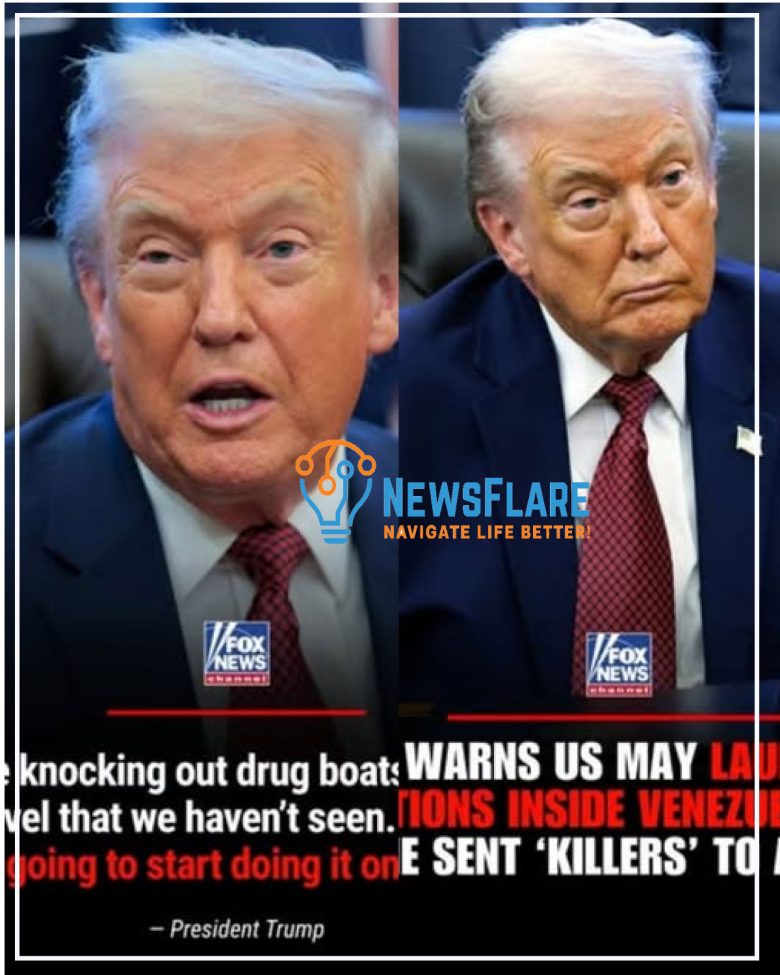
Washington hasn’t had a calm week in years—but this weekend, the political earthquake came from a direction nobody fully saw coming. Former President Donald Trump, speaking to supporters and reporters in a recent media appearance, hinted that the United States might consider launching land operations inside Venezuela.
Not as a confirmed policy.
Not as an official plan.
But as a possibility—one that instantly ignited a wildfire across American media and international newsrooms.
Trump’s remarks didn’t come quietly. They came with the kind of language that forces the world to stop scrolling and start asking whether something far bigger might be happening behind the scenes.
According to Trump, the Venezuelan government has allegedly allowed dangerous criminals to reach the United States. The comment instantly triggered widespread debate—not only in Washington, but across foreign policy circles and on social media where thousands of users immediately questioned whether the United States might actually be considering a ground strategy in South America.
Some called it “bold.”
Others called it “national security urgency.”
And many are calling it “potentially dangerous.”
But one thing is undisputed: this statement just changed the political conversation overnight.
⚡ “LAND OPERATIONS” — A Phrase That Set Off Alarms
In geopolitics, wording matters. Even a hypothetical possibility can become a diplomatic earthquake.
Trump didn’t confirm a mission. He didn’t outline a plan. But the very idea of U.S. troops entering South American territory raises questions that Washington has avoided for years.
Military intervention?
Border defense?
International response?
Diplomacy backlash?
Global alliances reacting?
Experts warn that the mere suggestion could cause tensions to rise quickly—not only between the U.S. and Venezuela, but across South America where political alliances are complex, shifting, and historically sensitive to American military presence.
Some analysts say it might simply be political rhetoric. Others believe it could hint at deeper concerns the public hasn’t been told yet.
That uncertainty alone is enough to spark a national debate.
🌎 Venezuela Responds — Carefully, But Firmly
In past disputes, Venezuelan authorities have pushed back whenever U.S. officials or political figures raised accusations or threats of intervention.
While official statements are still developing, many expect Venezuela to respond strongly, if not publicly, then through diplomatic channels and allied nations.
International observers warn that South American governments will be paying extremely close attention to Washington in the coming days.
One foreign policy expert wrote:
“When a former U.S. president mentions military action—even hypothetically—entire regions start reviewing their defense playbooks.”
🔥 Social Media Reactions: Fear, Support, and Confusion
Predictably, Twitter erupted. Supporters praised Trump’s toughness, arguing that stronger measures are necessary to protect national security. Critics accused him of escalating international tensions during an already volatile period.
Comments included:
-
“This is national security, not politics.”
-
“Is America about to start another foreign conflict?”
-
“We can’t afford this.”
-
“What if this actually happens?”
Some users expressed fear—not necessarily of Venezuela, but of the possibility that such a statement could pull the U.S. into unpredictable territory that could impact diplomacy, immigration, and domestic politics all at once.
🙅 The “Killer” Accusation — A Flashpoint
Even more controversial was Trump’s claim that Venezuela “sent killers into America.”
Journalists quickly pointed out that these are claims—statements made by a political figure—not confirmed evidence. Still, the phrase itself was enough to spark endless commentary.
Political analysts warn that strong language like this often becomes part of campaign narratives that shape public emotion more than public policy.
The phrase “sent killers” has become one of the most repeated sentences of the week—not because it’s proven, but because it’s dramatic, alarming, and impossible to ignore.
⚠️ Could the U.S. Actually Send Troops?
Most experts say no, at least not based on current information. There is no official military order. No Pentagon announcement. No confirmed plan.
But international politics doesn’t run on evidence—it runs on perception. And perception, once activated, can take on a life of its own.
The fear is not that action is imminent, but that even discussing such action could increase diplomatic tensions and create political instability.
🧨 Election Season — A Time When Every Word Becomes a Weapon
With the U.S. political climate heating up as election cycles approach, every statement—especially from a former president—becomes instantly dissected for political strategy.
Is this about:
-
national security?
-
foreign policy?
-
immigration debate?
-
campaign momentum?
-
or headline attention?
Political experts say timing is everything, and Trump’s remarks landed at a moment when voters are highly sensitive to border issues, international threats, and national security messaging.
🤝 What Foreign Allies Might Fear Most
America has global alliances watching every move it makes. If the United States even appears to be considering military intervention, other global powers could feel forced to react.
Countries aligned with Venezuela might issue statements. Others could quietly reevaluate alliances or strategic interests.
A former ambassador told media:
“Military language doesn’t just echo—it multiplies.”
One hypothetical sentence could ripple through embassies around the world.
🧩 “Why Now?” The Question America Can’t Stop Asking
Perhaps the biggest question of all is why now?
Why bring up Venezuela at this moment?
Why raise the possibility of operations?
Why use language that triggers global attention?
Was it:
-
a warning?
-
a political message?
-
a negotiation tactic?
-
or simply campaign-style rhetoric?
Nobody knows—but everyone wants to.
🔍 The Only Thing Clear: This Story Isn’t Going Away
Washington is already scrambling to interpret the meaning behind these statements. Media networks are preparing segments. Experts are lining up for interviews. And global governments are quietly preparing responses.
Whether anything actually happens almost doesn’t matter anymore. The statement itself is now part of the political conversation—the kind of conversation that shapes public perception long before official decisions are made.
For now, this remains a moment of words—not action.
But the echo of those words may be heard far beyond America’s borders.
🧨 Final Thought
Trump didn’t announce a military operation. He didn’t confirm one. He didn’t prove Venezuela “sent killers.”
But he said enough to send the political world into a frenzy.
A single sentence became a global headline.
A hypothetical scenario became a national debate.
And suddenly, the world is asking a question that no American expected to hear this week:
Is the United States preparing for something bigger—or is this just the beginning of a new political storm?
Whatever the truth is, one thing is certain:
America will be watching every word from now on.