
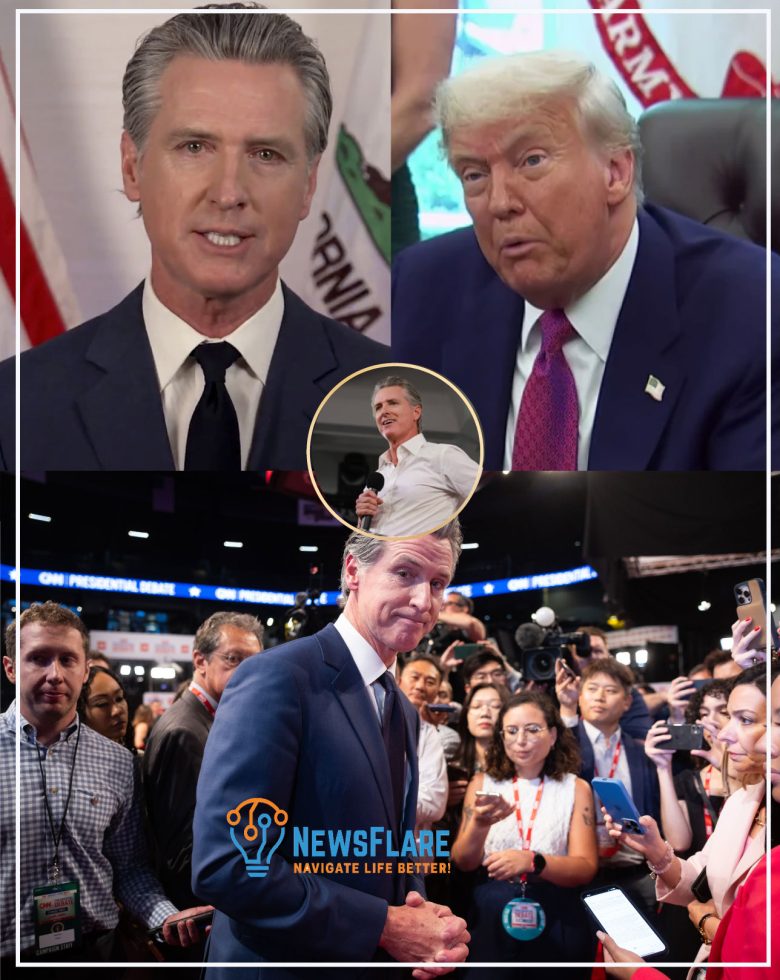
The political world erupted into a familiar mix of disbelief, amusement, and outrage after former President Donald Trump received what FIFA described as a special “peace prize” recognizing his supposed contributions to “promoting peace and unity.” The ceremony itself — complete with a medal, a trophy, and an ornate certificate — carried all the visual theatrics of an international honor. But the moment the announcement went public, the award immediately became a lightning rod for criticism, satire, and political commentary. And among the first to seize the moment was California Governor Gavin Newsom, who delivered one of the most memorable reactions of the day.
Newsom, known for his sharp rhetorical instincts and appetite for political confrontation, wasted no time mocking the award. He quipped that the so-called peace prize looked less like a meaningful international recognition and more like a “participation trophy” — the kind handed out to ensure no child leaves a soccer field feeling left out. His remark traveled quickly across social media, feeding into a narrative that Trump’s accolade was more spectacle than substance. And in many ways, Newsom’s reaction captured what critics across the political spectrum were already thinking: that the award felt oddly disconnected from Trump’s polarizing record, both domestically and internationally.
To understand why Newsom’s criticism resonated so widely, it helps to look closely at the moment’s symbolism — and the deeper political tensions underlying it. FIFA, the international governing body for soccer, has not traditionally presented peace prizes, nor has it played a formal role in awarding diplomatic or humanitarian honors. The gesture, therefore, struck many observers as unusual, if not strategically orchestrated. For supporters of Trump, the award offered a convenient narrative boost: an opportunity to position him as a figure of stability, global leadership, and reconciliation. But for critics, the ceremony felt more like a performance, one that glossed over the profound divisions and controversies that defined Trump’s presidency and continued to shape his post-White House persona.
Newsom’s framing of the award as a participation trophy wasn’t just a throwaway insult — it was a carefully calibrated message. Participation trophies symbolize effort without achievement, recognition without merit. By invoking that image, Newsom deliberately reframed Trump’s accolade as something ceremonial and hollow, stripped of the gravitas Trump’s team hoped it would project. And in doing so, Newsom placed himself squarely within the ongoing political battle over Trump’s legacy, positioning himself as a vocal counterweight to what he views as manufactured attempts to rehabilitate Trump’s image.
The timing of Newsom’s jab also reflects the larger political chessboard. With Trump dominating headlines and attention, especially in the lead-up to another election season, Democratic leaders have become increasingly aggressive in challenging narratives that portray him as a unifying or stabilizing figure. For Newsom — a rising national figure often discussed as a future presidential contender — moments like these serve a dual purpose. They allow him to reinforce his ideological stance while also building a reputation as one of the party’s most articulate and media-savvy critics of the former president.
But beyond the partisan sparring, the incident raises broader questions about the nature of political symbolism and the power of public perception. Awards, ceremonies, and honors have long been used to shape narratives around leadership. They act as shorthand — signaling legitimacy, credibility, or moral authority. For Trump’s supporters, the FIFA award becomes another emblem of international respect and recognition. For opponents, it becomes evidence of spectacle replacing substance.
The controversy also highlights a growing tension between traditional political validation and the increasingly theatrical nature of modern public life. In an era where viral moments often overshadow policy debates, the optics of an award can sometimes matter more than its origin or significance. Trump understands this intuitively; his political career has been deeply intertwined with branding, symbolism, and visual performance. A medal and a trophy, whether deeply meaningful or entirely manufactured, feed directly into the persona he has cultivated for years — a figure perpetually winning, perpetually celebrated, perpetually honored.
Newsom’s critique disrupts this narrative by stripping the moment of its intended prestige. Calling it a participation trophy reduces the award to something almost childish, trivial, unserious. It reframes Trump not as a statesman receiving an international honor but as someone being humored with symbolic gestures. And in the age of social media, framing often matters just as much as fact — sometimes even more.
Predictably, the reaction to Newsom’s comments split along sharply partisan lines. Progressive circles amplified his message, praising him for articulating what many believed was an obvious truth: that the award felt inflated, unearned, and out of sync with Trump’s actual record. Conservative commentators, meanwhile, accused Newsom of bitterness, elitism, or hypocrisy, arguing that his criticism reflected an unwillingness to acknowledge Trump’s influence on the world stage.
But the deeper significance of Newsom’s remarks lies not in the partisan reaction but in what they reveal about the evolving strategies of political communication. Both Trump and Newsom understand that in modern politics, controlling the narrative is just as important as advancing policy. Every headline, every viral clip, every public statement becomes a battlefield in the larger struggle over meaning.
In this sense, the FIFA award — and the debate surrounding it — becomes a microcosm of American political life. It reflects how even seemingly symbolic gestures can prompt cascading waves of interpretation, criticism, and strategic messaging. It reveals how political figures use cultural moments to sharpen their identities, reinforce their values, and challenge their opponents. And it shows how quickly the public conversation can shift, depending on who frames the event first and most effectively.
Ultimately, Newsom’s jab at Trump’s peace prize is about more than a trophy. It’s about the ongoing fight over political legitimacy, the narratives that shape public memory, and the symbols that leaders use to bolster — or undermine — one another’s credibility. In mocking the award as a participation trophy, Newsom not only dismissed the honor but also challenged the story Trump hoped it would tell.
Whether the FIFA award carries real weight is, in many ways, secondary. What matters most is how it will be remembered — as a symbol of international recognition, as a moment of political theater, or as a punchline in a rapidly accelerating rhetorical battle. And in that battle, Newsom has made his position unmistakably clear: some trophies shine brightly, but others are made to be mocked.